The $60 Million Bet: Is the Metalloid Deal Finally the Spark for Ghana’s Aluminium Revolution?
New $60M bauxite deal targets 1,500 jobs, but will it finally build the refineries Ghana has dreamed of for decades?
For decades, the dream of a “fully integrated” aluminium industry in Ghana has been the holy grail of national development. With an estimated 920 million tonnes of bauxite beneath the soil, the goal has always been simple but elusive: move beyond just digging and shipping raw ore to actually refining it into alumina and smelting it into aluminium right here on Ghanaian soil.
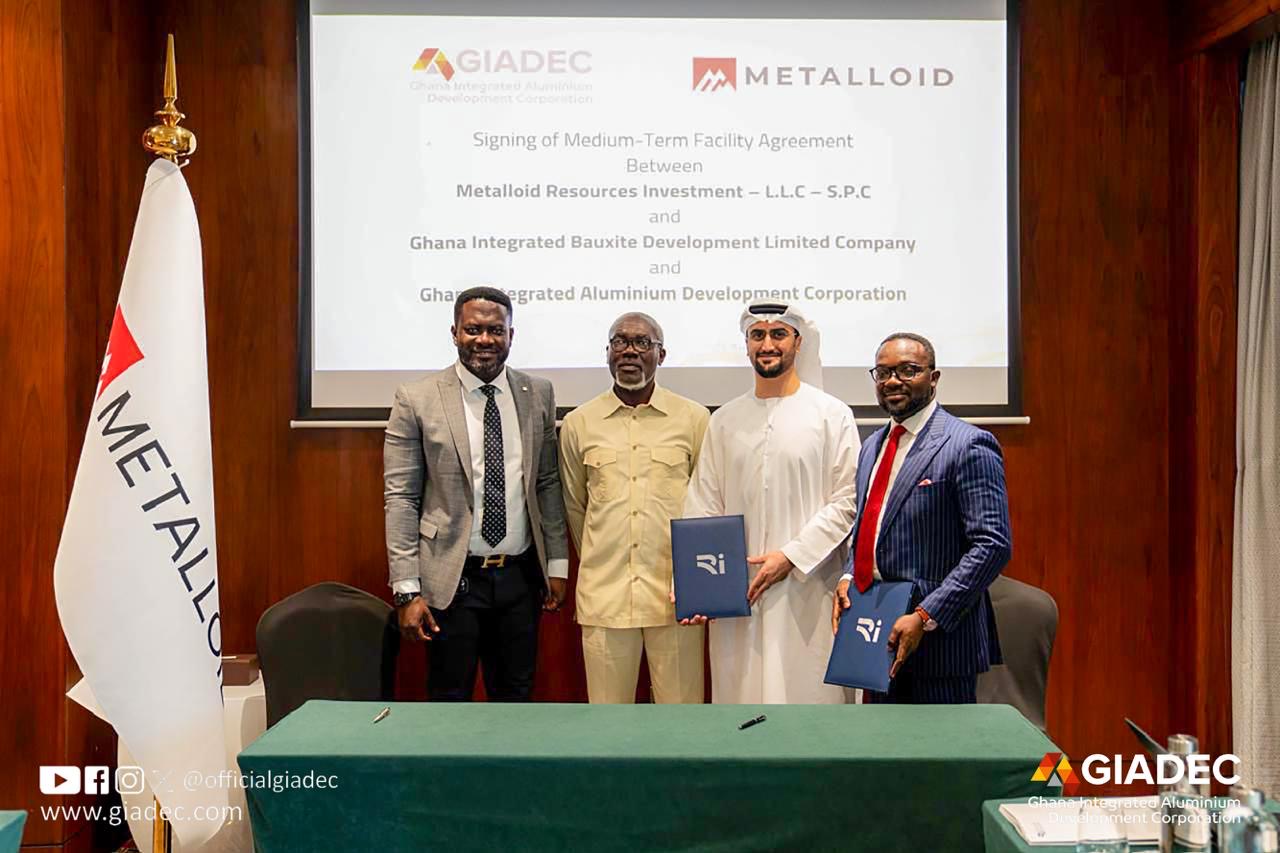
The recent signing of a US$60 million facility agreement between the Ghana Integrated Aluminium Development Corporation (GIADEC), Metalloid Resources Investment, and GIBDLC is the latest attempt to bridge this gap. This partnership targets mining at Hills 1-3 in Nyinahin, Ashanti Region, but as the ink dries, a familiar question hangs in the air: is this truly the beginning of a revolution, or is history simply repeating itself?
A History of False Starts and Legal Tussles
To understand the caution surrounding this new deal, one must look at the ghosts of projects past. The Nyinahin concession has long been a flashpoint for political and legal drama. Years ago, Engineers & Planners (E&P), led by Ibrahim Mahama, sought to explore these same bauxite reserves. However, in 2017, the government revoked the mining leases, citing a lack of necessary permits and statutory infractions. This sparked years of legal battles, eventually reaching the Supreme Court, which ruled the original leases invalid because they lacked parliamentary approval.
Following that era, the government pivoted to the $2 billion Sinohydro “Barter Deal.” The plan was to trade refined bauxite for massive infrastructure, including the interchanges and roads we see today. While some roads were built, the “integrated” part of the deal, the construction of domestic refineries faced significant delays. Critics argued the barter model prioritized immediate infrastructure over the long-term industrial goal of processing bauxite locally, leaving the “missing link” of a refinery still unbuilt.
The Road to a True Transformation
The new deal with Metalloid Resources is being pitched as a more disciplined, phased approach. Instead of a sweeping barter, this is a targeted investment into specific hills, aiming to scale up production while laying the foundation for a full value chain. However, for this $60 million spark to light a national fire, several structural hurdles must be cleared.
The first is the Energy Puzzle. Smelting aluminium is incredibly power-hungry. For Ghana to stop importing alumina for the VALCO smelter and start refining its own bauxite, it needs massive amounts of cheap, stable electricity. Without a dedicated power solution, potentially involving green energy to meet modern “Green Aluminium” standards, the bauxite will likely continue to leave our shores in its rawest, least valuable form.
The second hurdle is Infrastructure and Logistics. To move millions of tonnes of ore and finished products, the completion of the Western Rail Line is non-negotiable. Relying on heavy trucks to transport bauxite to the ports is not only expensive but damaging to national roads. Finally, there is the issue of Local Value. While the project promises 1,500 jobs, the real wealth lies in the “downstream” sector, manufacturing car parts, roofing sheets, and cans within Ghana rather than buying them back as finished imports.
A Crucial Step or Early Days?
GIADEC CEO Reindorf Twumasi Ankrah calls this a “crucial step,” and the $60 million investment is indeed a significant vote of confidence in Ghana’s resources during a period of global economic recovery. It represents a shift toward more transparent, specific partnerships.
Yet, history suggests that in the bauxite business, the “early days” can last decades. For the Metalloid deal to be remembered as the turning point, it must lead directly to the construction of a refinery and the modernization of VALCO. Until a Ghanaian-made aluminium ingot is produced from Nyinahin bauxite, the “Integrated Aluminium Industry” remains a dream that is finally waking up, but not yet standing on its own feet.
Credit: The High Street Journal